Explore three fictional psychiatric scenarios and the actual structured analyses produced by AI Psychiatry. See how the platform addresses diagnostic uncertainty, medication considerations, safety, decision-specific capacity, and disposition.
Clinical demonstration: Every patient scenario is fictional. The screenshots show actual application outputs from these synthetic cases; only the account identifier has been concealed. Outputs are decision support for clinician review, not autonomous diagnoses, prescriptions, or hospitalization orders. Verify clinical and prescribing details against current authoritative sources.
Simple workflow
From clinical information to structured analysis
The clinician enters the relevant case facts and questions. AI Psychiatry returns an integrated, organized analysis that can be reviewed alongside clinical judgment.
1
Present the case
Type or dictate the relevant history, mental status, medications, findings, and the clinical questions.
Consider uncertainty, perform needed evaluations, and verify medical and prescribing recommendations.
Your consultation workspace
Start with the full clinical picture.
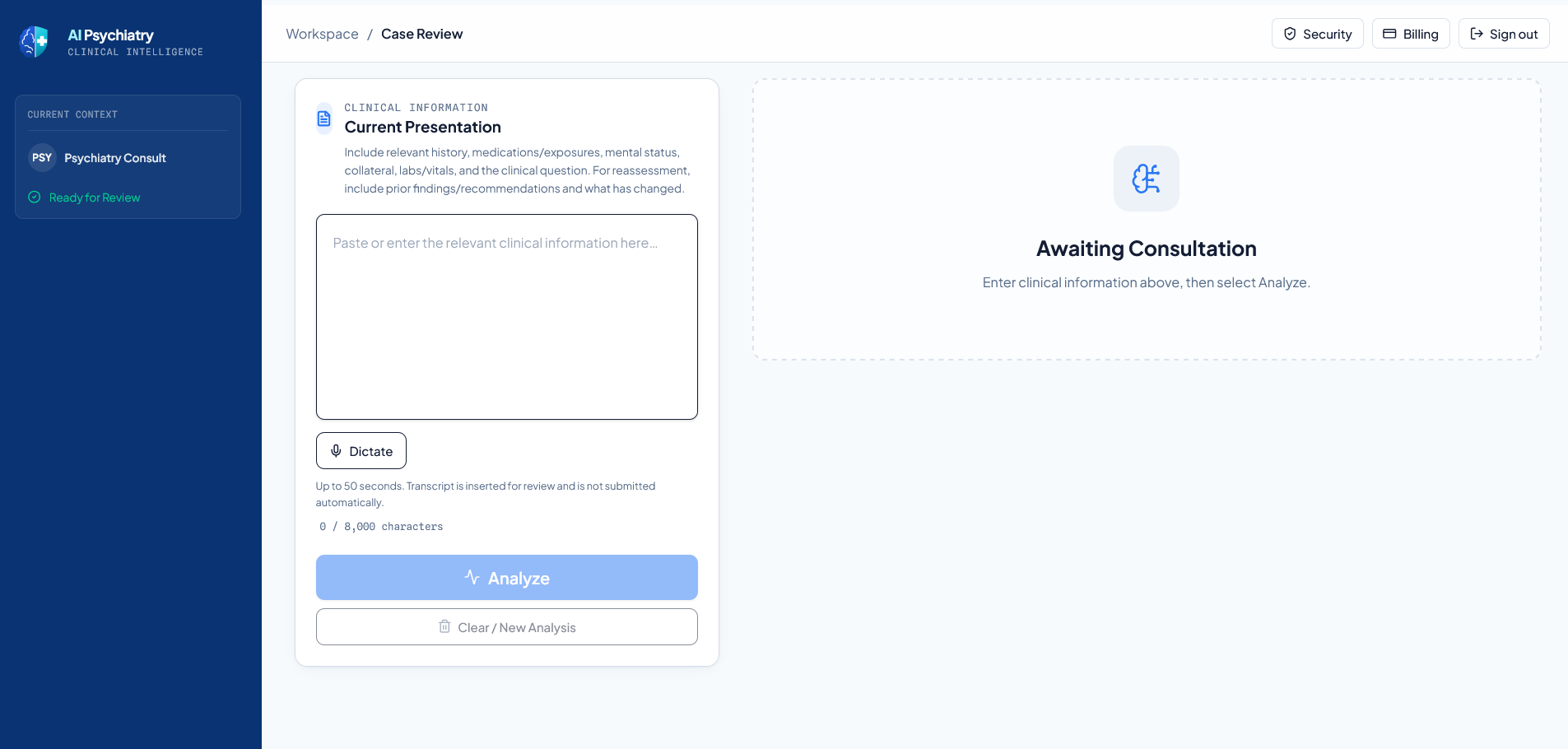
The application begins with a focused input screen for complete clinical cases—not a series of generic chatbot messages.
One concise dictation-style clinical narrative
One structured psychiatric analysis
Explicit safety and decision-specific capacity reasoning
Three representative clinical settings
Explore the actual case analyses.
Select View full case example or click a screenshot to read the original dictated case and zoom into the captured result at full available resolution.
CASE 01 · Primary care / outpatient
Depression with emerging hypomanic features
A patient with a depressive syndrome develops markedly reduced need for sleep, racing thoughts, and impulsive spending soon after an antidepressant dose increase.
What the actual output addresses
Bipolar-spectrum vulnerability versus antidepressant-associated activation remains unresolved.
Capacity to decline immediate ED assessment: intact on the documented interview.
Disposition: urgent outpatient psychiatry with a strengthened home safety plan.
38-year-old female with worsening depression over five weeks, including low mood, guilt, poor concentration, and intermittent passive death wishes. Denies active suicidal intent, plan, or prior attempts. Fluoxetine was increased from 20 to 40 mg ten days ago. Over the past four days, she's sleeping only three hours nightly without fatigue, has racing thoughts, increased talkativeness, and impulsive spending. Husband confirms these changes. Reports a possible similar episode years ago without antidepressants, and her sister has bipolar I disorder. No substance use or significant medical history. Vitals stable, alert and oriented, mildly pressured but redirectable, without psychosis.
Husband is supportive and can provide close supervision. No firearms at home. Patient prefers urgent outpatient psychiatric follow-up rather than ED evaluation. She understands the potential risks of worsening mania and suicidality and can explain her reasoning.
Please assess diagnosis, medication recommendations, suicide risk, capacity to decline ED evaluation, observation needs, and whether psychiatric hospitalization is indicated versus outpatient management.
CASE 02 · Urgent primary care
Acute psychosis during increased stimulant exposure
A patient taking twice the prescribed dose of stimulant develops persecutory delusions, dangerous behavior, and impaired capacity to refuse emergency evaluation.
What the actual output addresses
Stimulant-associated psychosis is favored; medical and primary psychiatric causes need evaluation.
Capacity to refuse emergency evaluation: impaired.
Psychiatric treatment: yes; psychiatric hospitalization: yes, subject to medical stabilization and reassessment.
Disposition: emergency department now; continuous observation and elopement precautions.
45-year-old male with ADHD brought by his sister for four days of severe insomnia, paranoia, and bizarre behavior. Believes neighbors are surveilling him through cameras and has been sleeping outside. Recently walked into traffic at night trying to escape perceived surveillance. Prescribed Adderall XR 20 mg daily but admits taking 40 mg daily for six days, along with multiple energy drinks. Intermittent cannabis use. No previous psychotic episodes.
Currently alert and oriented but markedly paranoid and difficult to redirect. Denies SI/HI but doesn't recognize the danger of his behavior. BP 148/92, HR 108, afebrile. Labs and toxicology pending; weapon access unknown. Sister cannot supervise him continuously.
Patient refuses ED evaluation, believing hospital staff are involved in the conspiracy. Although he can repeat the purpose of evaluation, he cannot appreciate the personal risks or meaningfully reason about treatment alternatives.
Please assess differential diagnosis, stimulant management, immediate safety, capacity to refuse emergency evaluation, observation, and need for psychiatric hospitalization and appropriate disposition.
CASE 03 · Hospital medicine consult
Delirium and capacity to leave against medical advice
An older hospitalized patient with pneumonia and acute kidney injury becomes fluctuatingly confused and tries to leave despite an ongoing oxygen requirement.
What the actual output addresses
Acute, multifactorial delirium is favored over primary psychiatric disease.
Capacity to leave the hospital against medical advice: impaired.
Disposition: continue medical hospitalization with enhanced observation and attention to QTc/renal constraints.
76-year-old female admitted three days ago for pneumonia, now with fluctuating confusion, paranoia, agitation, and attempts to leave AMA. Previously independent and cognitively intact per daughter. Overnight she accused staff of being impostors, removed her oxygen repeatedly, and attempted to leave. Currently calmer but inattentive, disoriented, and intermittently misidentifying family members. Denies SI/HI.
History includes CKD stage 3, hypertension, and anxiety without prior psychosis. Temperature 38.1°C, O2 saturation 91% on 2 L, sodium 128, creatinine 2.1 from baseline 1.1, QTc 512 ms. Receiving pneumonia treatment. Home sertraline 50 mg listed, adherence unclear. Received diphenhydramine twice and zolpidem once during hospitalization; other PRNs not fully reconciled.
Patient wants discharge but cannot explain her pneumonia, oxygen requirement, or risks of leaving. Her reasoning is dominated by paranoid beliefs, and responses fluctuate.
Please assess delirium versus primary psychiatric illness, capacity to leave AMA, agitation medication options given prolonged QTc and AKI, observation, and whether psychiatric hospitalization is indicated versus continued medical hospitalization.